


A family office in Bogotá, a U.S. taxable investor in Miami, and an institutional allocator may all want exposure to the same Florida real estate strategy. They should not necessarily enter through the same legal vehicle. The question, what is a parallel fund, matters because sophisticated capital requires both aligned economics and structures that respect distinct tax, regulatory, and reporting realities.
A parallel fund is not a marketing layer or a duplicate portfolio created for convenience. Properly designed, it is part of the investment architecture: a coordinated vehicle that allows different investor groups to participate in substantially the same strategy while preserving the legal and tax framework appropriate to each group.
Contents
Short answer: A parallel fund is a separate vehicle that invests alongside a main fund under the same mandate, in the same deals and at the same time, with allocations set by a predetermined methodology. It exists so investors with different legal or tax profiles, such as U.S. taxable and non-U.S. investors, can join one strategy through the structure that fits them. Before subscribing, verify the allocation provision, the economics and the administration and audit arrangements.
Related reading: how the Cayman parallel fund structure works for real estate and the quarterly reporting standards LPs should expect.
What Is a Parallel Fund?
A parallel fund is a separate investment fund that invests alongside a primary fund or another affiliated fund. Both vehicles generally pursue the same investment mandate, invest in the same underlying opportunities at the same time, and share allocations according to a predetermined methodology. Yet each fund has its own governing documents, investor base, capital commitments, accounts, and reporting obligations.
The central distinction is simple. Investors are not all placed into one pooled entity and asked to accept a one-size-fits-all structure. Instead, capital is organized through parallel vehicles so that each investor class can access a common strategy through the vehicle best suited to its jurisdiction, tax profile, and governance requirements.
For an international real estate manager, a common arrangement may involve a U.S. domestic fund operating alongside an offshore parallel fund, often established in a jurisdiction such as the Cayman Islands. The two vehicles may co-invest directly in an acquisition entity or participate through a common holding structure. The precise design depends on the asset, the investor mix, applicable securities rules, tax analysis, and the manager’s operational model.
A parallel fund does not eliminate tax obligations, investment risk, or the need for investor-specific advice. Its purpose is more disciplined: to organize cross-border capital in a manner that is coherent, documented, and capable of institutional administration.
Why Parallel Structures Exist
Private market investing becomes more complex when capital crosses borders. A domestic investor, a non-U.S. investor, a tax-exempt institution, and a family office may each face materially different considerations. Those can include IRS-governed U.S. withholding and filing exposure, entity classification, reporting standards, confidentiality preferences, and internal investment policy restrictions.
A single fund can work in certain circumstances. But when the investor base becomes more diverse, forcing every Limited Partner into one vehicle can introduce avoidable friction. The manager may need to reconcile conflicting tax objectives, legal eligibility questions, or governance expectations within a structure that was never built for that level of complexity.
The parallel model addresses this by separating the fund vehicles while aligning their investment purpose. The result is not absolute uniformity. It is controlled coordination.
For international investors seeking access to U.S. real estate, this distinction can be consequential. The investment opportunity may be in Miami or elsewhere in Florida, but the capital’s journey begins in another legal and fiscal environment. A properly structured offshore parallel fund can create a more appropriate entry point for eligible non-U.S. investors, subject to their own counsel’s review and the applicable laws of every relevant jurisdiction.
How a Parallel Fund Operates in Practice
The operating principle is economic alignment. When the manager identifies an eligible investment, each parallel vehicle generally contributes capital based on its investors’ commitments or another allocation formula disclosed in the governing documents. If one fund represents 60% of the combined committed capital and the other represents 40%, they would ordinarily participate in that proportion.
This requires more discipline than merely dividing a wire transfer. The manager must establish how investment opportunities are allocated, how expenses are shared, how management fees and carried interest are calculated, and how conflicts are disclosed and managed. These are not administrative details. They are the controls that protect fairness between investor groups.
Consider a value-add residential acquisition sourced off-market. The domestic fund and offshore parallel fund may both invest through a dedicated special purpose vehicle that acquires, rehabilitates, and repositions the asset. At exit, the proceeds flow back through the ownership structure to each fund, then to its respective investors according to the documents governing that vehicle.
The asset-level strategy can remain identical while the investor-level administration remains distinct. Each fund can maintain its own subscription process, capital account records, notices, financial statements, and tax reporting workflow. The underlying investment is coordinated; the investor relationship is properly segmented.
Evaluating a parallel fund structure for U.S. real estate exposure?
ARCSA Capital works with international investors on institutional access to prime residential assets in Miami and South Florida.
Request InformationAlignment must be documented, not assumed
A credible parallel fund structure is defined by its documentation and administration. The limited partnership agreement or equivalent governing document should address the fund’s mandate, investment period, fees, distributions, conflicts, transfer restrictions, valuation process, and winding-up provisions. Side letters may address specific institutional requirements, but they should not undermine equitable treatment or the core economics of the platform.
Equally important is a clear allocation policy. A manager may encounter opportunities that cannot be divided perfectly, particularly where an asset has a limited equity requirement or the investment involves special legal constraints. The policy should explain how those decisions are made, recorded, and reviewed.
Sophisticated LPs should expect a governance framework that separates commercial discretion from unchecked discretion. Investment committees, compliance oversight, independent fund administration, external audit processes, and disciplined recordkeeping each serve a purpose. They create a verifiable chain between capital commitment, asset acquisition, operational execution, and distribution.
Are You Structuring International Capital Into U.S. Real Estate?
ARCSA Capital works with family offices and institutional investors across Latin America to build parallel fund access to value-add real estate opportunities in South Florida.
Speak with Our TeamThe Role of a Cayman Parallel Fund
Cayman Islands structures are frequently used in global private capital because the jurisdiction is familiar to international institutional investors and can support a range of fund governance arrangements. That familiarity, however, should never be confused with a universal tax solution.
A Cayman parallel fund may be appropriate where non-U.S. investors seek participation in a U.S.-focused strategy without becoming direct investors in a domestic fund. Depending on the structure, it can also support investors who prefer an offshore vehicle for internal policy, consolidation, or administrative reasons.
Its effectiveness depends on the full architecture. The relevant analysis can involve the Cayman entity’s legal form, the U.S. investment holding structure, the nature of income generated, debt financing, withholding rules, investor residency, treaty positions, and reporting obligations. What benefits one investor may be unsuitable for another.
For that reason, the proper question is not whether Cayman is inherently advantageous. The right question is whether a Cayman parallel vehicle fits the specific investor, strategy, and transaction design after review by qualified U.S., offshore, and home-jurisdiction tax counsel.
What Investors Should Examine Before Committing
A parallel structure can signal institutional maturity, but the presence of multiple vehicles alone is not proof of quality. Investors should focus on the manager’s ability to administer the structure with precision over the life of the fund.
First, examine whether the investment allocation methodology is explicit. The fund documents should explain how opportunities, expenses, leverage, and distributions are attributed across vehicles. Vague language around manager discretion deserves careful scrutiny.
Second, assess governance and transparency. A sophisticated structure should provide consistent reporting standards, documented valuation practices, appropriate conflict controls, and a clear process for material investor communications. Offshore participation should not mean reduced visibility.
Third, understand the economics at both levels. Fees, carried interest, fund expenses, organizational costs, and transaction-level charges should be identifiable. Investors should know whether each parallel vehicle bears costs directly, proportionately, or through a shared arrangement.
Finally, confirm the operational depth behind the legal diagram. A structure is only as reliable as the manager’s underwriting, asset management, fund administration, compliance procedures, and ability to execute the stated strategy. In private real estate, governance and local operating control are inseparable.
Parallel Funds and Capital Protection
No fund structure can protect capital from market loss, execution failure, liquidity constraints, or changes in tax law. A parallel fund is not a substitute for investment due diligence. It does, however, reduce structural ambiguity when properly designed.
That matters especially in strategies built around special situations, off-market acquisitions, and compressed execution windows. Where a manager acquires residential assets in distress or repositioning scenarios, underwriting discipline must be matched by a capital structure that can receive commitments, deploy funds, track ownership, and distribute proceeds without procedural disorder.
At ARCSA Capital, the relevance of a parallel architecture is tied to that larger standard of control: coordinated access to U.S. real estate opportunities, institutional governance, and a framework designed for sophisticated international capital. The objective is not complexity for its own sake. It is precision where precision changes outcomes.
For the qualified investor, the most useful closing question is not simply whether a fund has an offshore parallel vehicle. It is whether every part of the structure — jurisdiction, governance, allocation, tax analysis, reporting, and asset-level execution — has been designed to serve the same disciplined investment mandate.
Access U.S. Real Estate Through a Properly Structured Parallel Fund
ARCSA Capital provides institutional-grade access to value-add residential acquisitions in South Florida, designed for sophisticated international capital.
Speak with Our TeamParallel Fund: 7 Points at a Glance
Most investors meet this structure through a subscription document rather than through an explanation. The seven points below summarize what a parallel fund actually does, why sponsors use it, and what a limited partner should verify before signing.
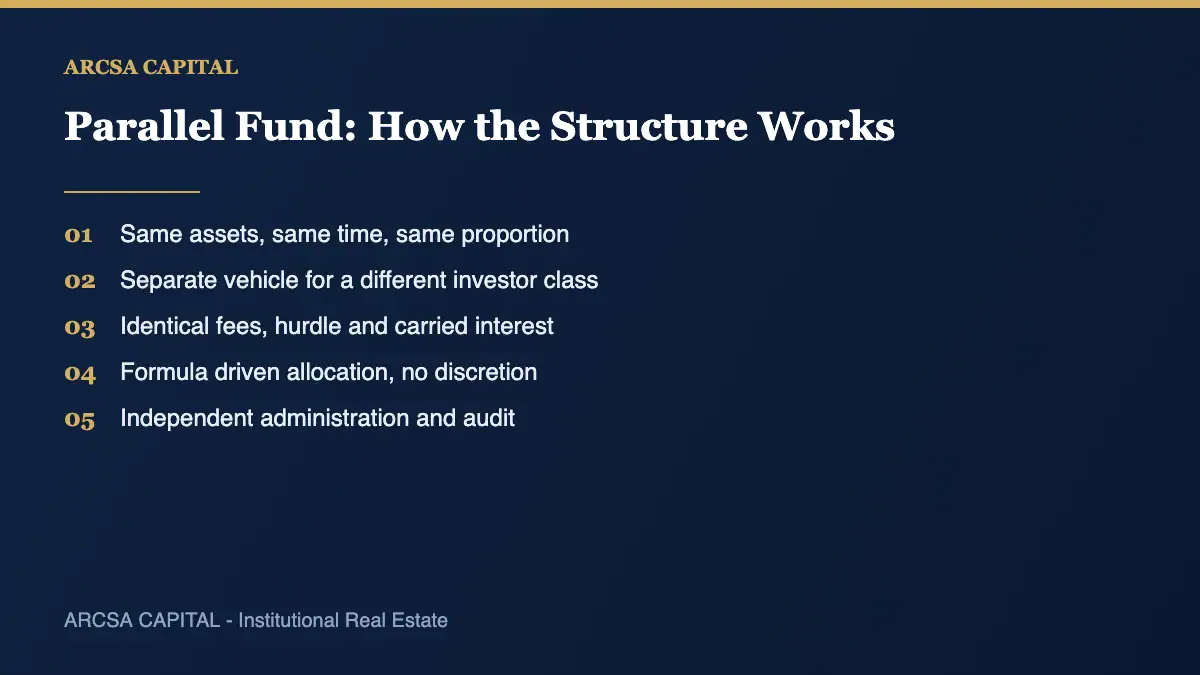
- A parallel fund invests side by side with a main vehicle, in the same assets, at the same time and in the same proportion.
- It exists to solve tax, regulatory or jurisdictional constraints that prevent one class of investor from entering the main fund directly.
- Economics are designed to be identical: the same fees, the same waterfall and the same carried interest across vehicles.
- Allocation policy is documented in advance so that no vehicle receives preferential access to a transaction.
- Governance sits with the same general partner, which keeps the investment decision unified across every parallel fund in the structure.
- Reporting should be consolidated so an investor sees both the vehicle level position and the underlying asset performance.
- A parallel fund is a solution to an investor constraint, never a mechanism for differentiated treatment.
Read together, these seven points explain why the structure is common in cross border real estate. The purpose of a parallel fund is to equalize access, not to create a second tier of participation, and any deviation from that principle deserves a direct question to the sponsor.
What Regulators and Public Filings Reveal About Parallel Fund
Private funds sold to qualified investors operate under federal rules governing private offerings, investor verification and continuing disclosure. When a sponsor uses a parallel fund to accommodate non United States investors, the same substantive protections should apply to every vehicle, and the offering documents should state explicitly how allocation, expenses and reporting are handled across them.
Offshore vehicles carry their own supervisory obligations. Cayman Islands structures, for example, are subject to registration, audit and anti money laundering requirements administered by the local regulator, and a well constructed parallel fund maintains independent administration and audited financial statements in each jurisdiction rather than relying on the sponsor own records.
Tax treatment is where the structure earns its existence. Blocker corporations, treaty considerations, withholding obligations and effectively connected income rules determine which investor can enter which vehicle, and those determinations belong to the investor tax adviser rather than to marketing material.
Any investor evaluating this type of structure should confirm how private offerings, investor qualification and ongoing disclosure are handled before committing capital. The framework published by the U.S. Securities and Exchange Commission is the reference point for assessing whether a parallel fund arrangement is properly documented.
Common Mistakes Investors Make With Parallel Fund
The structure itself is well established. Problems arise from how it is documented and administered, and those problems are visible before subscription if the right questions are asked.
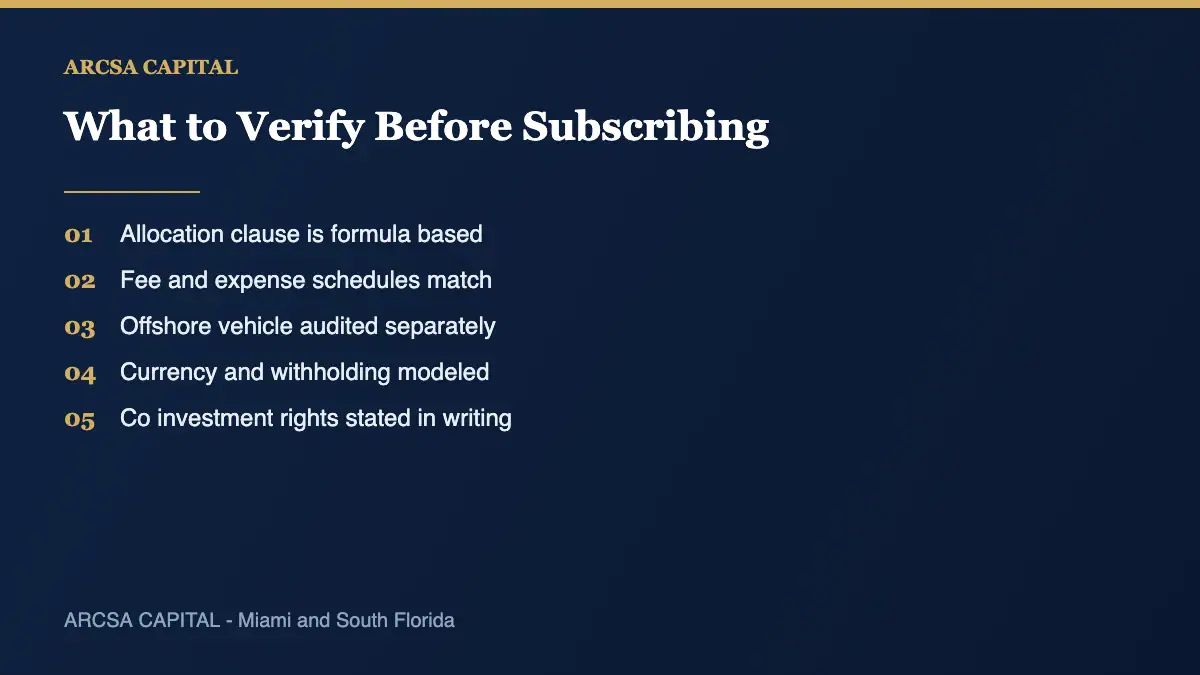
- Assuming that economics are identical across vehicles without reading the fee and expense allocation provisions.
- Accepting a verbal description of allocation policy instead of the written provision in the partnership agreement.
- Overlooking who bears the incremental administration, audit and legal costs of the offshore vehicle.
- Treating tax efficiency as a sponsor promise rather than as advice from the investor own tax counsel.
- Ignoring currency exposure when contributions and distributions cross jurisdictions.
- Failing to confirm that each parallel fund has independent administration and its own audited statements.
- Assuming co investment and follow on rights extend automatically to every vehicle in the structure.
None of these questions are difficult, and a competent sponsor answers them in writing without hesitation. Reluctance to document how a parallel fund allocates opportunities and expenses is itself the answer.
How to Evaluate Parallel Fund in 30 Days
Week 1 – Read the allocation provision
Locate the clause that governs how transactions are allocated between vehicles and read it literally. It should describe a proportional, formula driven allocation with no sponsor discretion to favor one parallel fund over another. Discretionary language is the single most important item to negotiate or reject.
Week 2 – Compare the economics line by line
Place the fee schedules of both vehicles side by side: management fee, carried interest, hurdle, catch up, organizational expenses and ongoing administration. Any divergence should have a documented rationale tied to jurisdictional cost rather than to investor category.
Week 3 – Confirm administration and audit
Ask for the administrator, auditor and legal counsel of each vehicle, and confirm that the offshore parallel fund is audited independently. Consolidated reporting produced solely by the sponsor without third party verification is a governance weakness regardless of the sponsor reputation.
Week 4 – Take independent tax advice
Have your own adviser confirm which vehicle is appropriate for your residency and entity type, how distributions will be characterized and what withholding applies. This is the step investors most often compress, and it is the one that determines net outcome.
Frequently Asked Questions About Parallel Fund
Is a parallel fund the same as a feeder fund?
No. A feeder invests into a master vehicle and holds an interest in that vehicle. A parallel fund holds the underlying assets directly, alongside the main fund, in the agreed proportion. The distinction matters for tax characterization, reporting and, in some cases, for creditor exposure.
Why is the Cayman Islands used so frequently?
It offers a mature, well supervised framework for pooled investment vehicles, established service providers and tax neutrality at the vehicle level, which allows investors to be taxed according to their own residency rather than twice. Neutrality at the vehicle level is not an exemption for the investor.
Do both vehicles receive identical returns?
Gross returns on the same assets should be identical by design. Net returns can differ because of withholding, jurisdictional expenses and currency movement. Those differences should be explainable line by line rather than treated as an unavoidable rounding difference.
Who decides which vehicle an investor joins?
The determination follows residency, entity type and tax status, and it should be confirmed by the investor own adviser. A sponsor can indicate which parallel fund is typically appropriate, but the responsibility for the decision remains with the investor.
What happens if the structures diverge over time?
They should not. If one vehicle participates in a transaction that the other does not, the partnership agreement must explain the mechanism and the investor should ask for the written rationale. Unexplained divergence is the clearest early warning in this type of structure.
Key Takeaways on Parallel Fund
- A parallel fund invests directly alongside the main vehicle in the same assets and proportions.
- It exists to solve investor level tax and regulatory constraints, not to segment investors commercially.
- Allocation policy must be formula driven and documented, never discretionary.
- Independent administration and audit in each jurisdiction are non negotiable.
- Net return differences should be explainable through withholding, expenses and currency.
- Tax suitability is a question for the investor own adviser, not for the sponsor.
- Unexplained divergence between vehicles is a governance failure worth acting on.
ARCSA Capital uses institutional structures, including parallel fund arrangements where appropriate, to give international investors access to prime residential real estate in Miami and selected Florida submarkets. This article is general information and does not constitute legal, tax or investment advice.
Understand the parallel fund structure before you commit capital
Speak with our team about vehicle selection, documentation and reporting for cross border allocations.
Request InformationOr model your own scenario in the investment simulator
Or receive the ARCSA Capital investment thesis by email, with the entry, stabilisation and exit assumptions behind the strategy:
